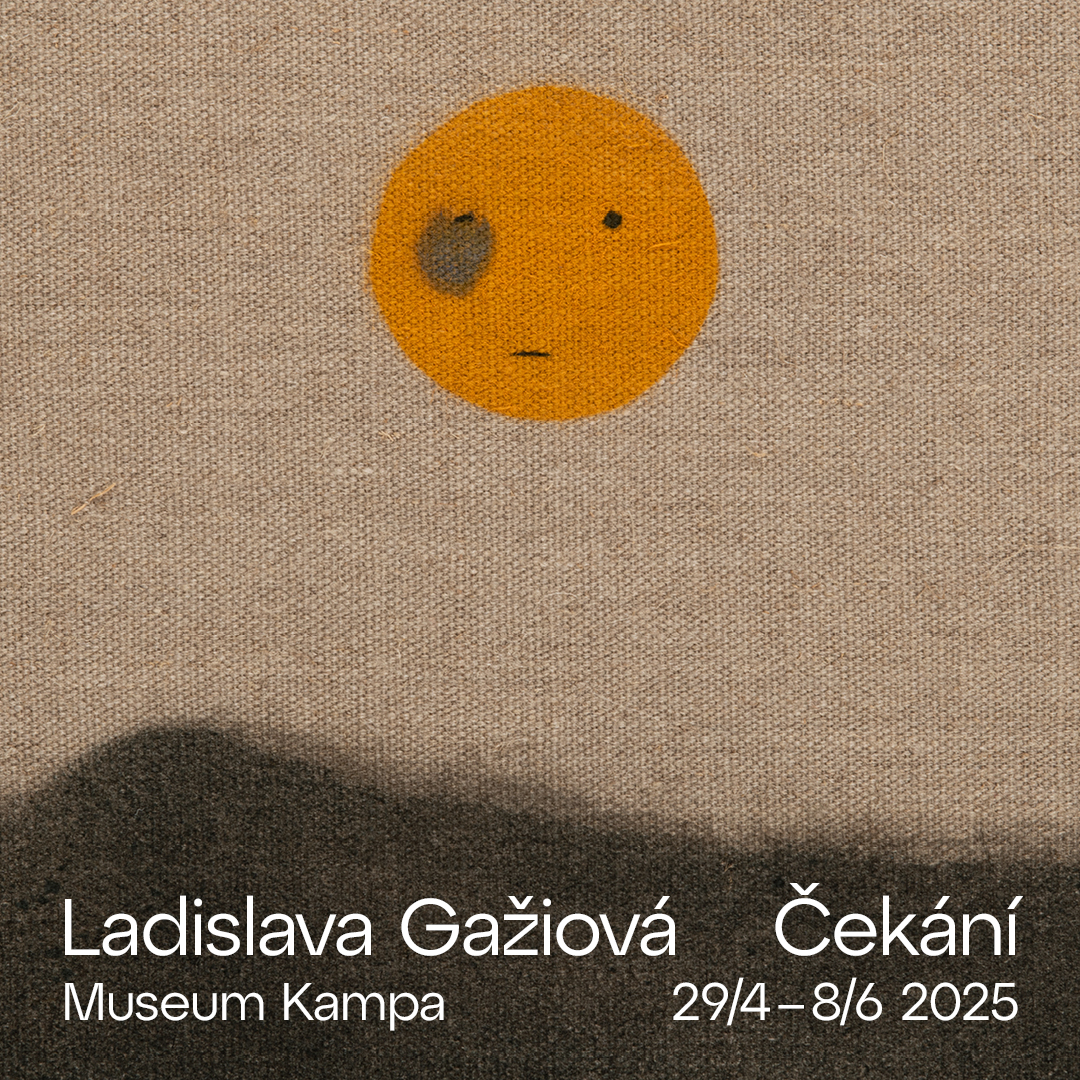
[vc_row content_text_aligment="" use_row_as_full_screen_section="no"][vc_column][vc_custom_heading text="29/4 – 8/6 2025" font_container="tag:h3|text_align:left" use_theme_fonts="yes"][/vc_column][/vc_row][vc_row content_text_aligment="" use_row_as_full_screen_section="no"][vc_column][vc_custom_heading text="Ladislava Gažiová – Čekání" use_theme_fonts="yes"][/vc_column][/vc_row][vc_row content_text_aligment="" use_row_as_full_screen_section="no"][vc_column][vc_column_text]Ladislava Gažiová (* 1981) is one of the outstanding personalities of the contemporary art scene. After two years of studies in Košice, she moved to Prague at the beginning of the millennium, where she attended the studios of Vladimír Skrepl at the Academy of Fine Arts and Jiří David at the Academy of Arts, Architecture and Design. She has had dozens of individual and group exhibitions in the Czech Republic and abroad. In addition to her own work, she has also curated exhibitions of other artists. In 2024, she became the second laureate of the Meda Mládek Prize. The expert jury, consisting of independent experts and representatives of Museum Kampa, recognised the uniqueness of Gažiová’s artistic expression and her ability to raise important social issues through her paintings and curatorial work. The exhibition Waiting in the premises of the so-called Stables will present a selection of Gažiová’s most recent works. It is the artist’s first major exhibition in nine years.[/vc_column_text][/vc_column][/vc_row]

[vc_row content_text_aligment="" use_row_as_full_screen_section="no"][vc_column][vc_custom_heading text="8/6 - 8/9 2024" font_container="tag:h3|text_align:left" use_theme_fonts="yes"][/vc_column][/vc_row][vc_row content_text_aligment="" use_row_as_full_screen_section="no"][vc_column][vc_custom_heading text="From Lines to Matter / Vojtěch Kovařík" use_theme_fonts="yes"][/vc_column][/vc_row][vc_row content_text_aligment="" use_row_as_full_screen_section="no"][vc_column][vc_column_text]If our destinies are predetermined, what place does that leave for free will? For luck? For chance? Vojtěch Kovařík confronts the issue in his paintings – and with the current exhibition at Museum Kampa, he steps into the third dimension: the smooth surface of his paintings are accompanied by reliefs and sculptures, with the artist’s path leading from lines that divide the canvas to sculptural works. The themes in this exhibition are universal, touching on the very foundations of Euro-American civilization. Even today in the third millennium, ancient myths, gods and goddesses, Titans, heroes and heroines are all still relevant, their robust forms exceeding the monumental format of the paintings. We may see them as archetypes, whose stories and actions have served since time immemorial to mark the limits and possibilities of our own passage through life and search for meaning. These oversized heroes are megalopsychoi, the great-souled men, the first individualities. Perhaps that is why we may only catch a glimpse of them through the window frame of the canvas, not in their entirety. Sisyphus sinks under the weight of his actions. The parting lovers Eros and Psyche suffer the burden of predestination. The labours of Heracles speak to the fulfilment of destiny, the first of these being to train the Nemean lion. Just as Zeus’s son made himself invulnerable wrapped in his lion skin, so too does the painter face more and more challenges that seem impossible to overcome. The reduced setting of the paintings consists of a stylized interior and Mediterranean landscape, fertile and arid, dusk or dawn, inlets, deserts, and oases. The artist’s approach is authentic: a unique syncresis of the influences of antiquity, modernity, and the digital present.

[vc_row content_text_aligment="" use_row_as_full_screen_section="no"][vc_column][vc_custom_heading text="18/2 - 30/3 2025" font_container="tag:h3|text_align:left" use_theme_fonts="yes"][/vc_column][/vc_row][vc_row content_text_aligment="" use_row_as_full_screen_section="no"][vc_column][vc_custom_heading text="VISIONS OF THE WORLD" use_theme_fonts="yes"][/vc_column][/vc_row][vc_row content_text_aligment="" use_row_as_full_screen_section="no"][vc_column][vc_column_text]This exhibition that presents works exclusively from the Wigam Collection is centered on two main visions of the world. In one space, the focus lies on the experience of the world through the body; while in the other, the world is, first and foremost, observed and lived through the social interdependencies. Needless to say, this distinction signals only the primary point of attention since one cannot think about the body without its social habitus and, conversely, the social order is personal and physical. Art is a place where values can and should be negotiated without being afraid to confront the public with difficult topics. These two visions, reflected in outstanding works made by some of the most interesting artists of our time, seem to be of great relevance at this moment. Participating artists: P. Barlow, G. Baselitz, M. Bourouissa, M. Cahn, J. Claracq, A. Cudahy, M. Eichwald, T. Emin, W. Fangor, L. Fratino, J. Gribbon, D. Hadjab, P. Halilaj, D. Hockney, N. Jaouda, C. Johnson, M. Jungwirth, M. Kara, A. Khorchid, V. Kovarik, X. Lei, A. Niles, H. Quinlan & R. Hastings, D. Richter, G. Rouy, J. Semmel, A. Slowak, P. Stasik, H. Steers, A. Szapocznikow, M. Thomas, K. Wang, A. Warhol, K. Wiley. Curator: Marta Gnyp Please note: the exhibition includes sexually explicit works.[/vc_column_text][/vc_column][/vc_row]

[vc_row content_text_aligment="" use_row_as_full_screen_section="no"][vc_column][vc_raw_html]JTVCem9icmF6X2RhdHVtX2tvbmFuaSU1RA==[/vc_raw_html][/vc_column][/vc_row][vc_row content_text_aligment="" use_row_as_full_screen_section="no"][vc_column][vc_custom_heading text="Identity - the story of Czech graphic design" use_theme_fonts="yes"][/vc_column][/vc_row][vc_row content_text_aligment="" use_row_as_full_screen_section="no"][vc_column][vc_column_text] The exhibition on all three floors of Museum Kampa shows the best of the history of Czech graphic design, i.e. works in which aesthetic quality, good technical realisation, craftsmanship and functionality go hand in hand. Visitors may see several hundred exhibits from the beginning of the 20th century to the present day: iconic posters, exquisitely designed books and magazines, dozens of logotypes, the development of state symbols and navigation systems, as well as exceptional examples of graphic design from the era of audiovisual media. The exhibition, curated by Filip Blažek, Linda Kudrnovská and David Korecký, is the part of the multi-genre project Identity – the story of Czech graphic design (www.projektidentita.cz), which includes a TV series broadcast in January and February 2024 on Czech Television, a forthcoming feature film on graphic design, which will be released in Czech cinemas on 10 October, and a book of the same name, which was published to accompany the exhibition and is also a monograph on graphic design.  The exhibition is divided into three floors thematically focused on public space, shared experiences and the private world. Iconic works will be highlighted through special labels with arrows to ensure that no visitor misses key exhibits. In accompanying texts, visitors may learn about the broader cultural, historical and political context of the exhibited artefacts, i.e. how graphic design influences society and vice versa. The exhibition is a joint project of the Kampa Museum, Typo and Mowshe. The graphic design is by Marvil studio, the architecture is by Adam Blažek, Jan Kloss and Matěj Činčera.[/vc_column_text][/vc_column][/vc_row]

[vc_row content_text_aligment="" use_row_as_full_screen_section="no"][vc_column][vc_raw_html]JTVCem9icmF6X2RhdHVtX2tvbmFuaSU1RA==[/vc_raw_html][/vc_column][/vc_row][vc_row content_text_aligment="" use_row_as_full_screen_section="no"][vc_column][vc_custom_heading text="Ludmila Seefried Matějková / Before the Door" use_theme_fonts="yes"][/vc_column][/vc_row][vc_row content_text_aligment="" use_row_as_full_screen_section="no"][vc_column][vc_column_text]Ludmila Seefried Matějková (*1938) developed her artistic course for most of her life outside her homeland, specifically in West German Berlin, where she moved in 1967. She returned to the Czech Republic in 2015. Her sculptural and drawing work reflects the horrors of war, the monstrosities of the Stalinist 1950s and the hardships of life in exile. Motifs of direct violence and pain are accompanied by deep insights into the human soul with its silent dramas, such as uprooting, loss of self-esteem, self-torture, apathy, or, on the contrary, questioning, self-awareness and contemplation. The exhibition in Museum Kampa will present a selection of Matějková's work, ranging from early polyester sculptures (Scream, Hanna, Before the Door) to several works in baked clay (The Beggar, Nab, Strangulation). The exhibition will be accompanied by a diary publication with Matějková's memories of her time behind and before the Iron Curtain.  Here, the author uses authentic language to describe the political and social context of the time and its influence on the formation of her artistic language. In the same colourful way, she presents her work of her public space projects in Berlin and in a trio of literary short stories she explains the creation of the sculptures (Hanna, The Beggar, Nab) which will be on display.   Partner of the exhibition:[/vc_column_text][/vc_column][/vc_row][vc_row content_text_aligment="" use_row_as_full_screen_section="no"][vc_column][vc_single_image image="8416" img_size="full" onclick="custom_link" link="http://www.lkpumpservice.cz/"][/vc_column][/vc_row]

[vc_row content_text_aligment="" use_row_as_full_screen_section="no"][vc_column][vc_raw_html]JTVCem9icmF6X2RhdHVtX2tvbmFuaSU1RA==[/vc_raw_html][/vc_column][/vc_row][vc_row content_text_aligment="" use_row_as_full_screen_section="no"][vc_column][vc_custom_heading text="Vladimír Houdek: Set of All Movements" use_theme_fonts="yes"][/vc_column][/vc_row][vc_row content_text_aligment="" use_row_as_full_screen_section="no"][vc_column][vc_column_text]It is not difficult to imagine moving from one point to another, from point A to point B. Indeed, the number of points in the universe far exceeds the number of letters in the alphabet, in any alphabet, whether we see them or only assume they are there. How much movement takes place without us being aware of it, without us being able to keep track? What exactly falls within the set of all movements? People move across cities, regions, and continents. They criss-cross the planet. Stars and planets orbit vast galaxies. Molecules vibrate within matter. We study the regularity and deviation of movement between and around points, describing ellipses and ecliptics, the fluctuations of Brownian motion. In order to comprehend all these changes, we create schemata and diagrams, systems of rules. The world is one boundless continuous change, a ceaseless movement. Our ideas about the future have been shaped by modernity and its various utopian schemes. We go back to the crossroads to gaze upon the systems and hypotheses of the past. Among its expansions and centrifugal forces, we search for a centre. Vladimír Houdek’s work revolves around the artificialism of Štyrský and Toyen, the black paintings of Suprematism, Kandinsky’s alchemy and reflections on the spiritual in art. Houdek consistently draws on such materials as books and maps – the guides that lead us through an unknown world. Houdek’s process goes through many stages as he works and reworks layers of acrylic paint, adding, drying, cutting, removing. Alongside these paintings, he also works in gouache and collage. To the glowing alabaster and black expanses of his earlier canvases come the colours of the spectrum, particularly yellow. The titles of his series and exhibitions convey the energy of words:

[vc_row content_text_aligment="" use_row_as_full_screen_section="no"][vc_column][vc_custom_heading text="8/2 - 21/4 2025" font_container="tag:h3|text_align:left" use_theme_fonts="yes"][/vc_column][/vc_row][vc_row content_text_aligment="" use_row_as_full_screen_section="no"][vc_column][vc_custom_heading text="Tomáš Rajlich – the Sculptor" use_theme_fonts="yes"][/vc_column][/vc_row][vc_row content_text_aligment="" use_row_as_full_screen_section="no"][vc_column][vc_column_text]While Tomas Rajlich is known today mainly as a minimalist painter, he originally studied sculpture at the Academy of Fine Arts in Prague. An exhibition at former stables of Museum Kampa in early 2025 will focus on Rajlich’s sculptural work from the 1960s. Three dozen of his metal and plastic sculptures and several early geometric drawings will be on display, all are works from before 1969, when he went into exile in the Netherlands. Tomas Rajlich, who will celebrate his 85th birthday during the exhibition, was, together with Jiří Hilmar, Radek Kratina and Arsén Pohribný, one of the founding members of the Concretists Club (Klub konkretistů) in 1967. In the Netherlands, he worked as a teacher at the Academy in the Hague and collaborated with the Yvon Lambert Gallery in Paris. He returned to the Czech Republic for good in 2010. A comprehensive retrospective of his paintings, in which his work gradually evolved from black geometric rasters to shimmering monochromes of pastel colours, took place at the Museum Kampa in 2017. Partners of the exhibition: [/vc_column_text][/vc_column][/vc_row][vc_row content_text_aligment="" use_row_as_full_screen_section="no"][vc_column][vc_single_image image="8416" img_size="full" onclick="custom_link" img_link_target="_blank" link="http://www.lkpumpservice.cz/"][vc_single_image image="8860" img_size="full"][/vc_column][/vc_row]

[vc_row content_text_aligment="" use_row_as_full_screen_section="no"][vc_column][vc_raw_html]JTVCem9icmF6X2RhdHVtX2tvbmFuaSU1RA==[/vc_raw_html][/vc_column][/vc_row][vc_row content_text_aligment="" use_row_as_full_screen_section="no"][vc_column][vc_custom_heading text="Preparing for Darkness, Vol. 8" use_theme_fonts="yes"][/vc_column][/vc_row][vc_row content_text_aligment="" use_row_as_full_screen_section="no"][vc_column][vc_column_text]About the exhibition / curator’s statement It’s time for a divorce. A divorce from a type of contemporary art and especially painting that seems suspended in eternal post-modernity; one that, through a marked lack of artistic skill, can’t seem to reference anything but itself. This state of modern art can be experienced as a “pluriverse” of styles, citations, and allusions without a semblance of internal coherence.  With my exhibition series “Preparing for Darkness”, I would like to pose a counter concept. The 8th edition of the series takes place at Museum Kampa and presents 13 artists - mostly painters - who stand as examples of a generation marked by an exceptional intellectual approach to artistic practices. The resulting profound examination of art history, paired with extraordinary artistic skill, can be seen as veritable and imminent, as they each, through their own unique style, offer a real, pictorially comprehensible and perceptible dialogue between past art and their own inscribed emotional world. What unites them is a resurrection of melancholy, which returns to highlight the magical in a viewing experience. In that sense, my chosen metaphor “Preparing for Darkness'' is meant to describe both melancholy and the state of the world. Uwe Goldenstein Artists Nicola Samorì (I), Enrico Minguzzi (I), Flavia Pitis (RO), Radu Belcin (RO), Adela Janska (CZ), Richard Stipl (CZ), Daniel Pitín (CZ), Adam Magyar (H), Attila Szűcs (H), Inna Artemova (D), Adam Bota (A), Liu Langqing (CH) & Rafael Megall (ARM / in collaboration with Demetrio Paparoni) [/vc_column_text][/vc_column][/vc_row]