


[vc_row content_text_aligment="" use_row_as_full_screen_section="no"][vc_column][vc_custom_heading text="KOPECKÝ FOREVER" use_theme_fonts="yes"][vc_custom_heading text="Opens 25 April 2026" font_container="tag:h3|text_align:left" use_theme_fonts="yes"][vc_column_text] The exhibition presents nearly twenty works by the legendary artist Vladimír Kopecký (b. 1931, Svojanov) spanning from the 1960s to the present. This focused selection brings together painting, drawing, and glasswork as equal components of his oeuvre. Kopecký’s work is built on the constant transformation of his own artistic language—an alternation of gestural spontaneity and construction, colour patches and lines, order and tension. Individual approaches build upon one another and return in new forms without ever repeating themselves. The exhibition traces this internal continuity: amidst the diversity of expressions, a single artist remains present—a single way of thinking and working that transforms over time but never loses its intensity. [/vc_column_text][/vc_column][/vc_row]
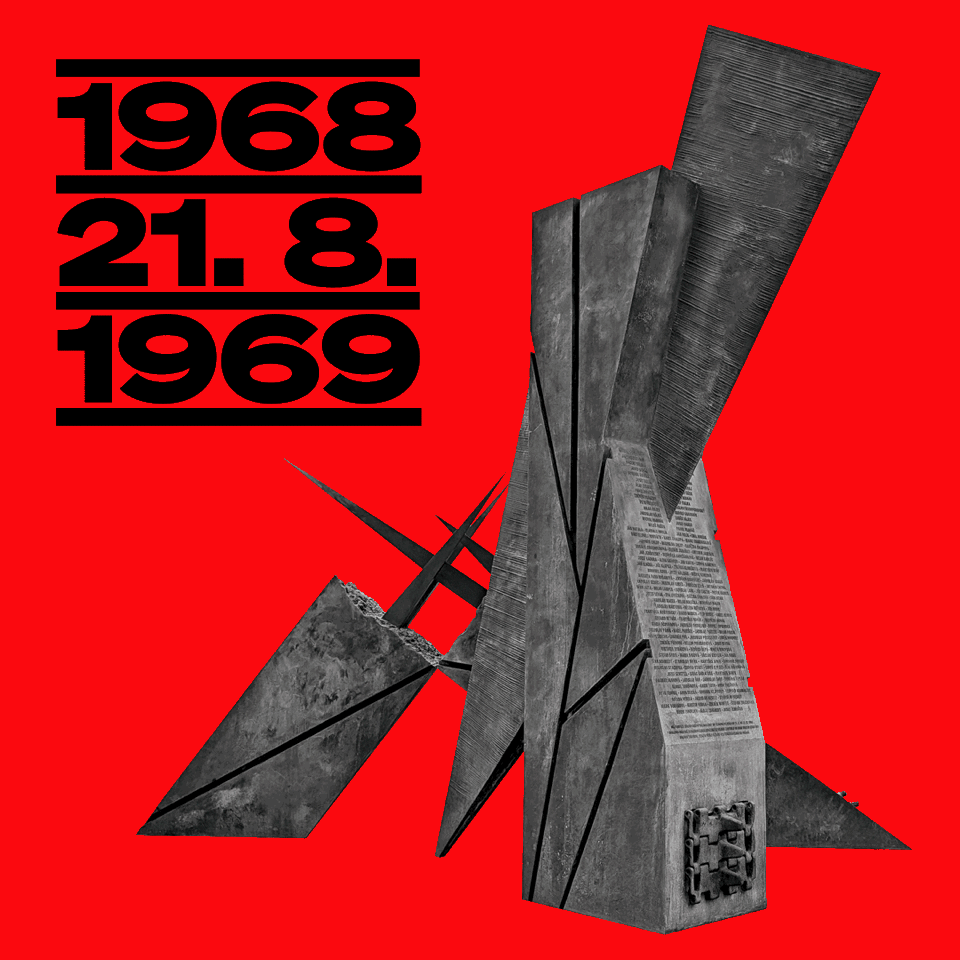
[vc_row content_text_aligment="" use_row_as_full_screen_section="no"][vc_column][vc_raw_html]JTVCem9icmF6X2RhdHVtX2tvbmFuaSU1RA==[/vc_raw_html][/vc_column][/vc_row][vc_row content_text_aligment="" use_row_as_full_screen_section="no"][vc_column][vc_custom_heading text="Jiří SOZANSKÝ – August 1968 / 1969" use_theme_fonts="yes"][/vc_column][/vc_row][vc_row content_text_aligment="" use_row_as_full_screen_section="no"][vc_column][vc_column_text]In his work, Jiří Sozanský (*1946) has long thematised traumatic moments of Czech history from the times of Nazi and Communist totalitarianism. In his sculpture August 1968/1969, he focuses on the breaking point brought upon the society by the invasion of the Warsaw Pact troops in August 1968 and the onset of the so-called ‘normalisation’ in the following year. The cultural and political thaw of 1968 was understood by many as a breath of freedom after twenty years of rigid totalitarianism. This revival process was destroyed by the invasion of the occupation forces of the Soviet Union, Poland, Hungary, Bulgaria and East Germany on the night of 20 August. In the sculpture, the year 1968 is represented by an erected obelisk, into which a giant wedge is diagonally embedded, like a knife wound or a lightning strike. The year 1969 is depicted as an obelisk or a crossbar broken in half. While the August invasion was an intervention from the outside, the tragedy of 1969 consisted in the acceptance of the occupation by the political representation of the state and a large part of its citizens and in the repressive crackdown on those who wanted to express their civil dissent. The August 1969 crackdown was not carried out by the occupation troops but by the domestic security, paramilitary and military forces.[/vc_column_text][vc_column_text] Historical context — The Legacy of the Two August Anniversaries[/vc_column_text][/vc_column][/vc_row]

The Lilli Lonngren Anders Collection of František Kupka and The Central Europe Art Collection

Václav Cigler, Václav Boštík, Aleš Veselý, Karel Malich, Jiří Anderle, Zdeněk Sýkora, Pavel Nešleha and others

Jan Kotík, Kamil Lhoták, Vladimír Boudník, Milan Grygar, Josef Hampl, Jan Koblasa, Karel Malich and others