
Pavel Rudolf (born 1943 in Brno) is one of the most significant representatives of conceptual abstract art. His natural sense of connecting rational thinking and intuition soon resulted in a specific artistic opinion based on “‘the purity of the initial concept and a focus on the viewer’s mind and intellect’, as the art theorist Jiří Valoch aptly assessed.
The exhibition at the Kampa Museum showcases a selection of Rudolf’s work from the 1960s to the present day, with a particular focus on his paintings. In his earliest paintings, he straddles the boundary between figurative art and abstraction by drawing on remnants of human figures and transforming them into concise artistic compositions. These paintings were precursors to compositions approaching totemic symbols, built on a language of stylised zoomorphic, anthropomorphic or biomorphic forms (Bez názvu [Untitled], 1966).
During the 1970s and 1980s, Rudolf created paintings on paper, combining rational elements such as transformation, determination, spatial progression and projection with emotionally charged, expressive painting. These works address the processes of decay and explosion, or conversely, intergrowth and extension. Examples include the medium-sized paintings on cardboard from the late 1970s, such as Podivná geneze (Strange Genesis, 1978) and Moře – Planeta (Sea – Planet, 1978), as well as the large-format paintings on paper or canvas blinds from the second half of the 1980s. An important formal counterbalance to these expressive pieces is the series of works on paper Bez názvu I–VIII (Untitled I–VIII, 1988), in which the artist repeated and arranged stripped-down geometric shapes to create radical rhythmic structures.
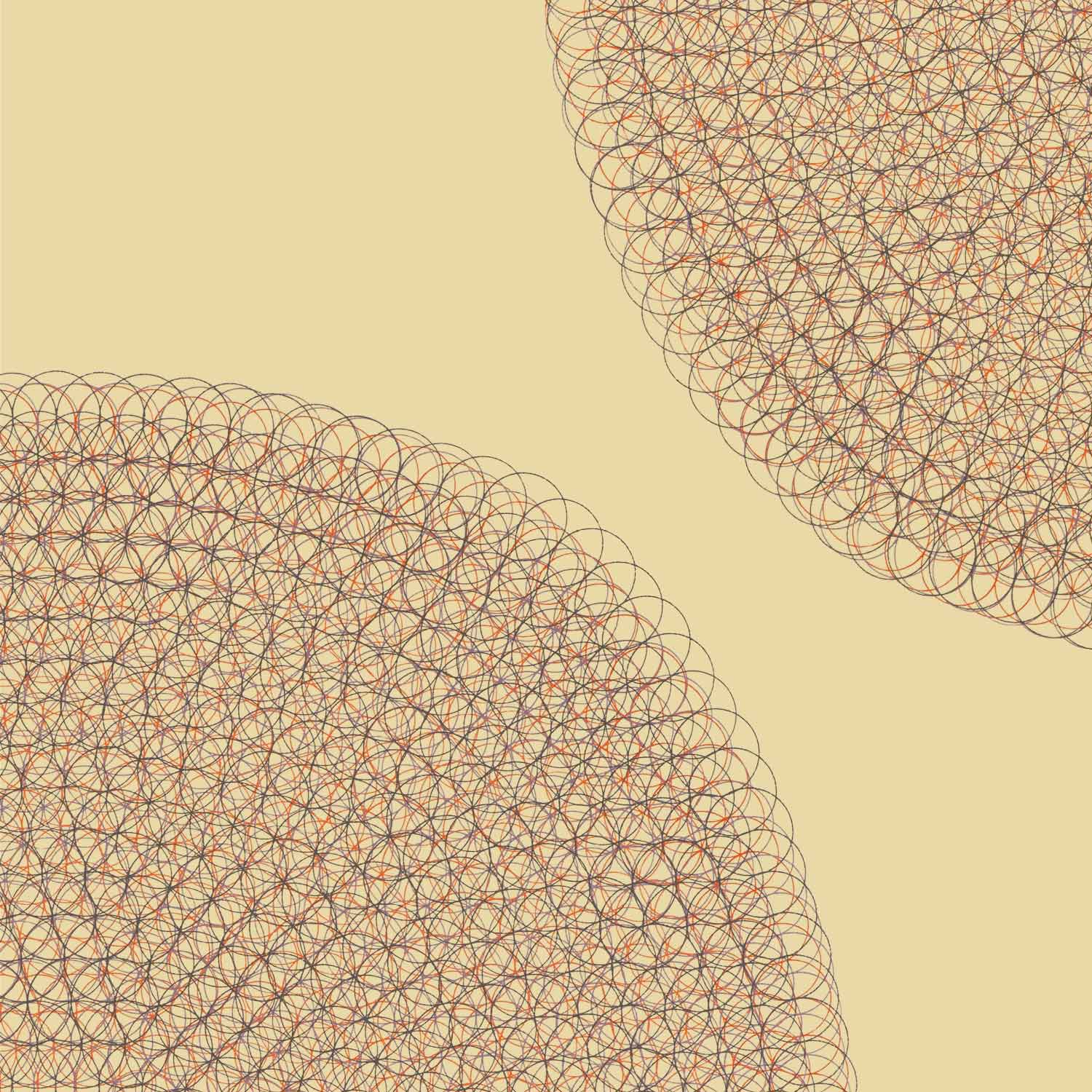
Since 1998, Pavel Rudolf has worked continuously in the medium of classical acrylic-on-canvas painting. In these neo-constructivist paintings, he builds on his earlier interest in transforming geometric shapes by moving points along set paths. This time, however, he manipulates geometric shapes — circles, semicircles or segments of circles — on the canvas, which he draws with a compass. He arranges or overlaps the selected shapes in rows to create a horizontal-vertical grid or arranges them in a specific shape, such as a circle, thereby emphasising the geometric form itself in the structure (Uspořádání [Arrangement], 2001, collection of Museum Kampa). These works explore not only the organisation of the initial element, but also the choice of colours, which has evolved over the years (Uspořádání [Arrangement], 1998, collection of Museum Kampa). While Rudolf’s earlier paintings tended to be limited to radical black and white colours or monochromatic tones, his more recent works often arrive at more sophisticated solutions in terms of both the combinatorics of arranging individual structural elements and determining their colours. Through this concept, Rudolf has achieved more complex compositions in recent years, based on a rich colour palette and intricate structure (Uspořádání Arrangement, 2019), using the medium of classical painting, drawing and computer graphics.
Through his consistent body of work from the 1960s to the present day, Pavel Rudolf has enriched the art scene with his original approach to conceptual constructivism, which can be appreciated both intellectually and through sensory experience. Within this approach, Rudolf’s work has recently matured, moving towards an increasingly emphatic aesthetic of colour structures without undermining the original concept in any way.
Ilona Víchová, 2025
Pavel Rudolf
- Born 21 June, 1943 in Brno
- From 1959 to 1963, he studied at the School of Arts and Crafts in Brno
- From 1963 to 1967, he studied at the Faculty of Education in Brno (majoring in Art Education and Mathematics)
- Lives and works in Brno-Řečkovice