
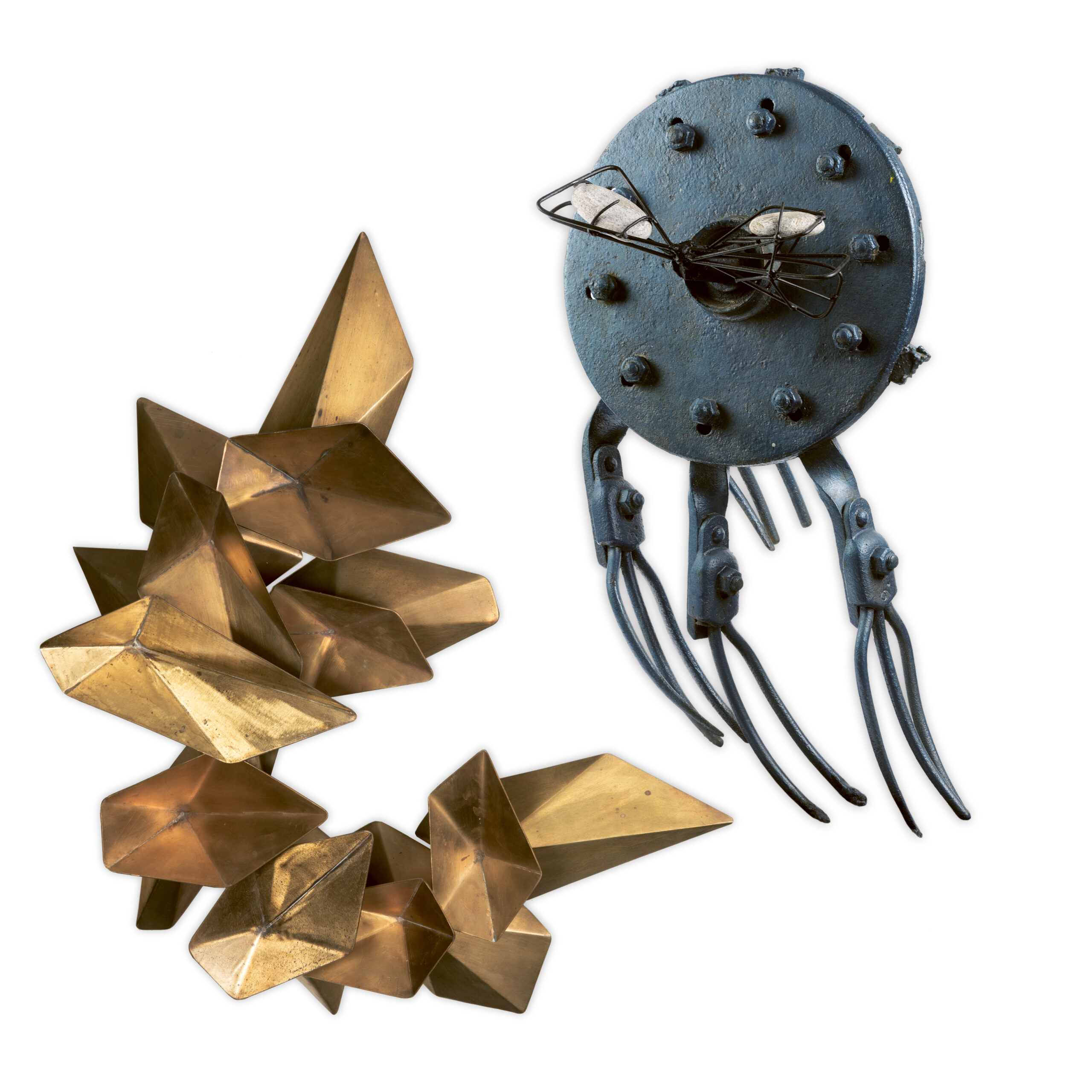
Above all, the opportunity to exhibit the works of VALERIAN KAROUŠEK (1929–1970) and JIŘÍ NOVÁK (1922–2010) is an opportunity to recall the creative principles with which both sculptors contributed to the new figurative and constructivist tendencies in Czech art in the 1960s. It also conveys the vibrancy of a space for sharing contemporary ideas and exploring different themes and creative approaches to working with new materials. However, it also recalls the powerful life stories of both artists, which were shaped by historical events and the political circumstances in the country.
Both artists studied sculpture at the Academy of Fine Arts in Prague and were members of the M 57 group. They participated in the Czechoslovak pavilion exhibition at the 1958 World Exhibition in Brussels, exhibited at the Socha 1964 (Sculpture 1964) and Socha a město (Sculpture and City) outdoor exhibitions in Liberec in 1969, and created a number of sculptures for urban space. They both found artistic inspiration in the natural environment and in the latest technical possibilities of modern civilisation. Valerian Karoušek combined the substance of stone worked by natural forces with industrial metal fragments and constructions in his sculptures, and he was also interested in the sculptural possibilities of experimenting with plastic materials. He naturally combined his artistic endeavours with his lifelong interest in mountaineering and fascination with the earth element.
The current exhibition also commemorates the tragedy of the Czechoslovak mountaineering expedition to the Peruvian Andes in 1970, which cut short his successful career as a sculptor. Jiří Novák based the expressive effect of his works on his natural interest in constructions and mechanisms, his romantic perception of reality and his brilliant ability to compose spatial structures, primarily from metal. When integrating movement into sculpture, he worked with the principle of chance and the interplay of the organic and mechanical. Of the elements, he was primarily interested in air and water. He also devoted himself intensively to restoring sculptures and creating copies.
However, the current exhibition of both artists’ works highlights their semantic overlaps, reflecting today’s intuitive ideological currents that integrate science, religion, art and philosophy. These currents are inspired by the rediscovery of humanity’s essential sensitivity to natural elements and its ability to recognise its inner connection with the cosmos. This reopens the space for these works to impact today’s viewers.
Iva Mladičová